






A flat roof that holds water after rain, shows cracks around an edge or starts staining the ceiling below needs more than a quick patch. Choosing the best material for flat roof replacement affects how well your home stands up to wind, rain, UV exposure and the changing temperatures of a British year. The right answer is rarely the cheapest covering available. It is the system that suits the roof’s size, shape, condition and expected use, installed properly from the deck upwards.
For homes across the South East, EPDM rubber, GRP fibreglass, high-performance felt and liquid-applied systems are all proven options. Each can give dependable protection, but they are not interchangeable. Understanding the differences helps you make a sound decision before work begins.
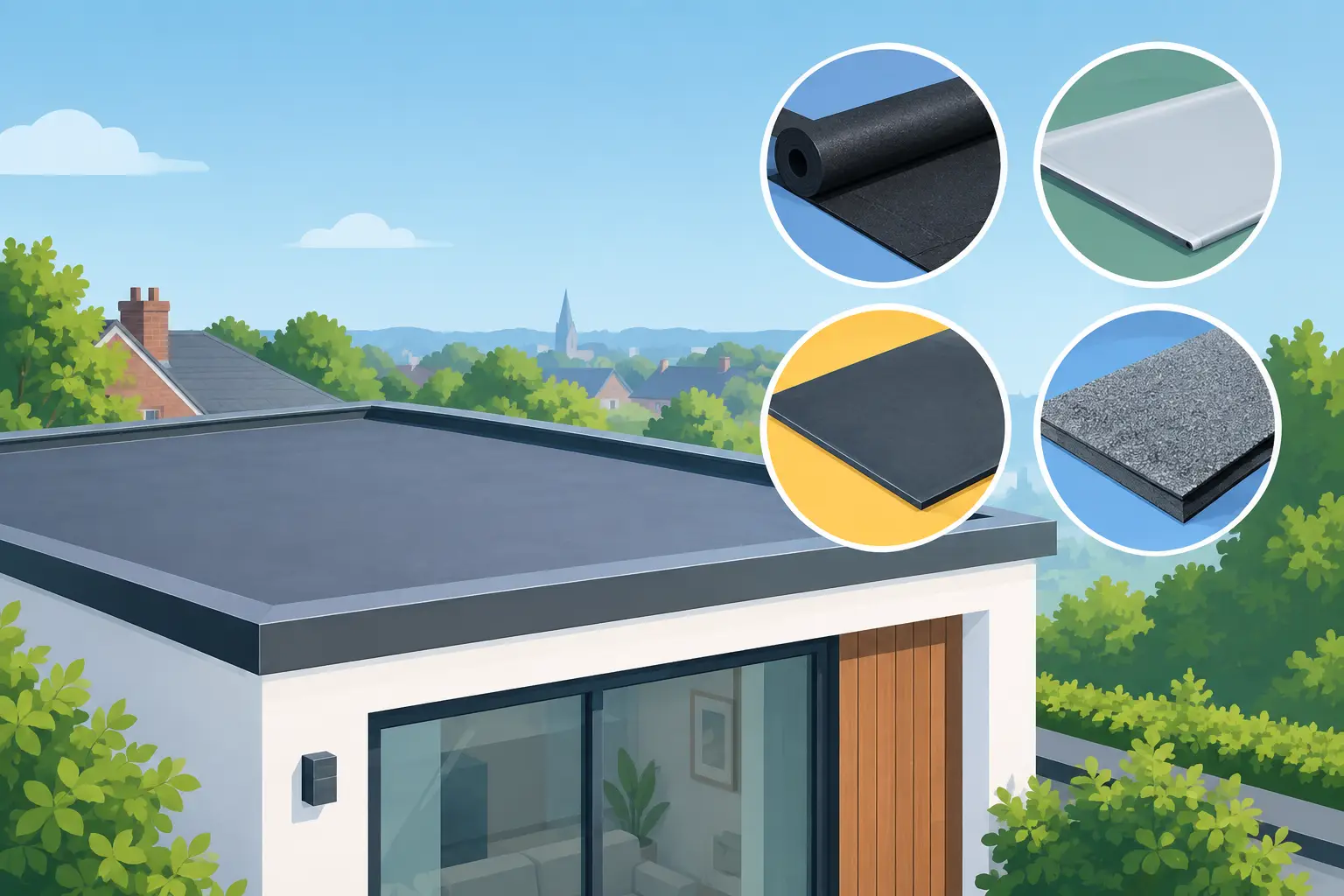
Choosing the best material for flat roof replacement
The roof covering is only one part of the decision. A durable result depends on the structure beneath it, the roof’s drainage, the insulation arrangement and the detail around abutments, pipes, rooflights and gutters. A premium membrane will not solve a deck that has deteriorated or a roof laid with insufficient falls.
A professional assessment should establish whether the existing roof can be overlaid or needs stripping back. Overlaying can sometimes reduce disruption and cost, but only where the deck is dry, sound and free from trapped defects. If water has entered the build-up, removing the old layers is normally the safer long-term approach.
It is also worth considering how the roof will be used. A small garage roof has different demands from a main flat roof over a bedroom, a bay window, an extension or a roof terrace. Foot traffic for window cleaning or maintenance, for example, may require a more resilient finish or designated walkways.
EPDM rubber roofing
EPDM is a synthetic rubber membrane and one of the most popular choices for domestic flat roofs. It is usually supplied in large sheets, which means a modest-sized roof can often be covered with very few seams. Fewer joins can reduce potential weak points when the material is fitted correctly.
Its main strengths are flexibility and weather resistance. EPDM copes well with normal building movement and temperature changes, making it a particularly good fit for extensions, garages, dormers and outbuildings. It has a clean, understated appearance and generally requires little routine maintenance beyond keeping outlets and gutters clear.
The trade-off is that edge details and adhesive work need careful preparation. The roof deck must be smooth, dry and stable, while trims, corners and penetrations must be finished to a high standard. EPDM can offer a long service life, often several decades, but this depends heavily on the system used and the quality of installation.
GRP fibreglass roofing
GRP, often called fibreglass roofing, creates a tough, seamless surface. The system is formed using resin and reinforcing matting, then finished with a protective topcoat. Once cured, it produces a smart, hard-wearing roof with no welded or bonded sheet seams across the main area.
This makes GRP particularly suitable for smaller, more detailed roofs where a seamless finish is valuable, such as porches, bays, balconies and compact extensions. It can also be finished in different colours, although dark grey remains a common choice for residential properties.
GRP needs dry conditions and disciplined workmanship during installation. Resin ratios, curing times and the preparation of the roof deck all matter. It is less forgiving of movement than a flexible rubber membrane, so the substrate must be properly specified and fixed. On a well-built, stable roof, GRP can provide excellent, attractive protection. On a roof with underlying movement or poor detailing, cracking can become an issue.
High-performance felt roofing
Modern felt roofing should not be confused with older, basic mineral felt products that many homeowners associate with short-lived repairs. High-performance felt systems use multiple layers of modified bitumen, usually applied with specialist techniques and finished with a durable cap sheet.
A quality felt system remains a practical and reliable choice for many flat roofs. It is versatile, works well across varied roof shapes and is often competitively priced. It can also be a sensible option where access is restricted or where a roof has complex details that need careful formation.
Its longevity varies by product specification and installation quality. As a general guide, a professionally fitted high-performance system may last around 15 to 25 years, with higher-specification installations capable of longer service. Seams and laps are part of the design, so workmanship is especially important around joints, edges and outlets.
For homeowners balancing cost and dependable performance, felt should not be dismissed. The key is to ask what grade of felt system is proposed, how many layers are included and how the contractor will deal with the roof’s drainage points and perimeter details.
Liquid-applied waterproofing
Liquid roofing systems are applied as a coating that cures into a continuous waterproof membrane. They are especially useful where a roof has awkward shapes, numerous penetrations or details that would be difficult to cover neatly with sheet materials.
Because the material is applied in liquid form, it can form around pipes, upstands, corners and rooflight bases without creating multiple separate joints. In some cases, a liquid system may be used to refurbish an existing roof, provided the underlying surface is structurally sound, dry and compatible with the product.
The condition of the existing roof is critical. A liquid coating is not a cure for wet insulation, rotten decking or widespread movement. Thickness also needs to be controlled carefully to achieve the intended performance. When specified for the right roof and applied by trained professionals, liquid systems can be an effective answer to complex repair and refurbishment work.
What about single-ply membranes?
Single-ply membranes, including PVC and TPO systems, are widely used on commercial buildings and can also be appropriate for larger domestic flat roofs. They are lightweight, durable and heat-welded at the seams. For a sizeable extension or a property with several connected flat roof areas, they may be worth considering.
For many smaller residential roofs, however, EPDM, GRP or high-performance felt may be a more familiar and proportionate solution. The best choice should be based on the roof rather than on whichever material is most commonly advertised.
Insulation and drainage matter as much as the covering
A new flat roof is an opportunity to address heat loss and moisture risk. Most replacement projects involving a main roof area will need to consider current Building Regulations requirements for insulation. A warm roof construction, where insulation sits above the structural deck, is often preferred because it helps keep the deck warmer and reduces the risk of condensation within the roof structure.
Drainage deserves the same attention. Flat roofs are built with a slight fall to direct water towards outlets, gutters or scuppers. Ponding water can shorten the life of any material and may indicate inadequate falls, blocked outlets or deck movement. A few shallow patches of water after rainfall are not always an immediate failure, but water that remains for days should be investigated.
Before agreeing to a replacement, make sure the proposed work explains whether new falls, insulation, fascias, gutters, upstands and flashing details are included. Comparing quotations only by the visible roof covering can leave important work unaccounted for.
How to make a confident choice
For a straightforward garage, dormer or extension roof, EPDM is often a strong all-round option because it is flexible, low-maintenance and long-lasting. GRP can be ideal for smaller roofs needing a seamless, crisp finish, provided the deck is stable. High-performance felt offers proven value and adaptability, while liquid systems are highly useful for complex shapes and certain refurbishments.
Ask any roofing contractor to explain why their recommendation suits your particular roof, rather than simply accepting a material name. You should receive a clear scope of work covering the condition of the deck, insulation, drainage, edge trims, flashing details and the guarantee provided. Photographs of the roof before, during and after work are also valuable evidence of what has been done.
The most reassuring choice is a material matched to a properly prepared roof and installed with care at every detail. Revive Roofing Solutions can assess the condition of your flat roof and help you choose a durable solution that protects your property for the years ahead.